

003 — Wordsmoke
A student’s map of Oxford, the trauma of Finals and a fun game to play with license plates

Welcome back to The Notebooks. If you missed the last, this is where we were.
If you’re coming in fresh, The Notebooks is a piece of long form writing, based on a true story, served in weekly instalments. You can read it yourself or listen to me read it (audio linked above).
Pieces in The Notebooks may have a song-matching, like wine and cheese.
Song-match this piece with: The Coral, Dreaming of You.
Not your quick-release serotonin fix, The Notebooks are in it for the long haul.
Now re-opening The Notebooks to June 2006….
I said this was going to be a High Fidelity mash-up, so let’s talk about fidelity.
Fidelity to the truth? Nah, this is fiction. It’s an exploration of a past, in many ways resembling my own, but it could be anybody’s. Anybody defined (involuntarily) by financial crisis and the new millenium; by weighty expectations, failures and what often (universally?) felt like the wrong choices.
I read Zen and the Art of Archery last week (frankly: don’t bother) and learned from it this one thing: zen aims for the obliteration of the self.
Did you know that? I didn’t. In the context of writing, it is interesting to me.
If zen is the obliteration of the self, literacy may be its highest form of expression.
Hear me out.
Reading, you can obliterate yourself. It’s why I read what other people have to say about things that have happened to them. The more rich and varied perspectives I consume, the more I obliterate myself and my own limitations.
The anodyne is seldom recorded and, weirdly, I have always wanted more of the humdrum. I want to see life in all its quotidian blandness from another set of eyes. An obsession with historical fiction in my young adult phase, as if I could read my way into knowing what it felt like to be on the Mayflower, in Ancient Rome, a starlet in 40s Hollywood or a child in wall-building China. This has always been one of my bugbears when it comes to fantasy or a piece of fiction with cool world-building. Like, let me see more of what’s it’s really like, how it works. Spare me the dramatic narrative, the denouement. I want to spy on the humdrum and marvel at the everyday. I want to see what the post office looks like in Cicero’s Rome or what a casual lunch looked like in Gilgamesh’s Mesopotamia. I want to know what the markets along the Bosphorus smelled like two thousand years ago and what kind of shitters they had on Viking ships.
A prolific Substacker wrote recently about reading (most) books as a waste of time. Don’t want to read books? Think it’s a waste of time? Prefer to stay trapped behind one set of eyes only? Please. Spare me this parochial prisoner’s outlook. You need to zen out, mate. Get off the rat wheel and stop yearning for neat, tidy parcels of information that can be drunk like a smoothie, without moving from your desk, in the most efficient manner possible. Maybe step away from the non-fiction.
What about writing? Is that zen? Surely that’s not obliteration of the self. If anything, it’s the opposite: relentless naval-gazing. This may explain the impression I get that it’s narcissistic for a woman to write about herself (particularly outside the true life context of overcoming some gruelling adversity, learning tough life lessons, etc). As an aside, I have seldom seen men who write about themselves accused of the same narcissism (or, if they are, they are lionised anyway; ref Hemingway).
So, narcissistic. Unimaginative, I grant you, but narcissistic? I am necessarily hemmed in by one body and one perspective on the things that have happened to me. If I write about it, does that make me a narcissist? I would submit that the obliteration of the self in fact lies in writing about one’s self without ego or artifice. Presenting the experience of a life lived as a detached narrative, without any attempt to inflate, alter or enhance.
Simply put: these are all the things I did.
But, like I’ve written before, writing the truth about one’s own life — particularly when that life is a woman’s life — has its challenges. People seem to be much more comfortable with writers of fiction. Maybe fictionalising your life is the zen high-water mark; the real obliteration of the self into an invented self.
Who can say.
I aim for fiction, and sometimes fall short, lacking imagination, constrained to my one body and definitely not zen-like enough.
And, anyway, things can’t ever be recorded with complete fidelity.
—
Robert Macfarlane has written how walking the same piece of land makes it intensely familiar to you. Walking it barefoot makes it even more familiar.
The land I just wrote about in Town and Country, I could walk that, map it with my soles, barefoot, backwards and blindfolded.
I never walked barefoot anywhere in Oxford, except maybe once or twice walking home from a club, blistered and briefly shoeless. Despite its reputation for leafy quads, lush riverbanks and whispering meadows, Oxford isn’t a great place for walking barefoot. Lots of broken glass, smeared take-away remains and a really surprising amount of vomit that I have, at times, bolstered. Like the first night of Fresher’s week, splattering bright pink vodka cranberry all over the side of the Bodleian library, while my new friends looked on with glee.
Wondering how many generations of previous students had vomited just there in that exact same spot lent the occasion a touch of consequence.
Anyway, even though I seldom walked Oxford barefoot, with my French manicured toes, I can still map it.
Here it is:
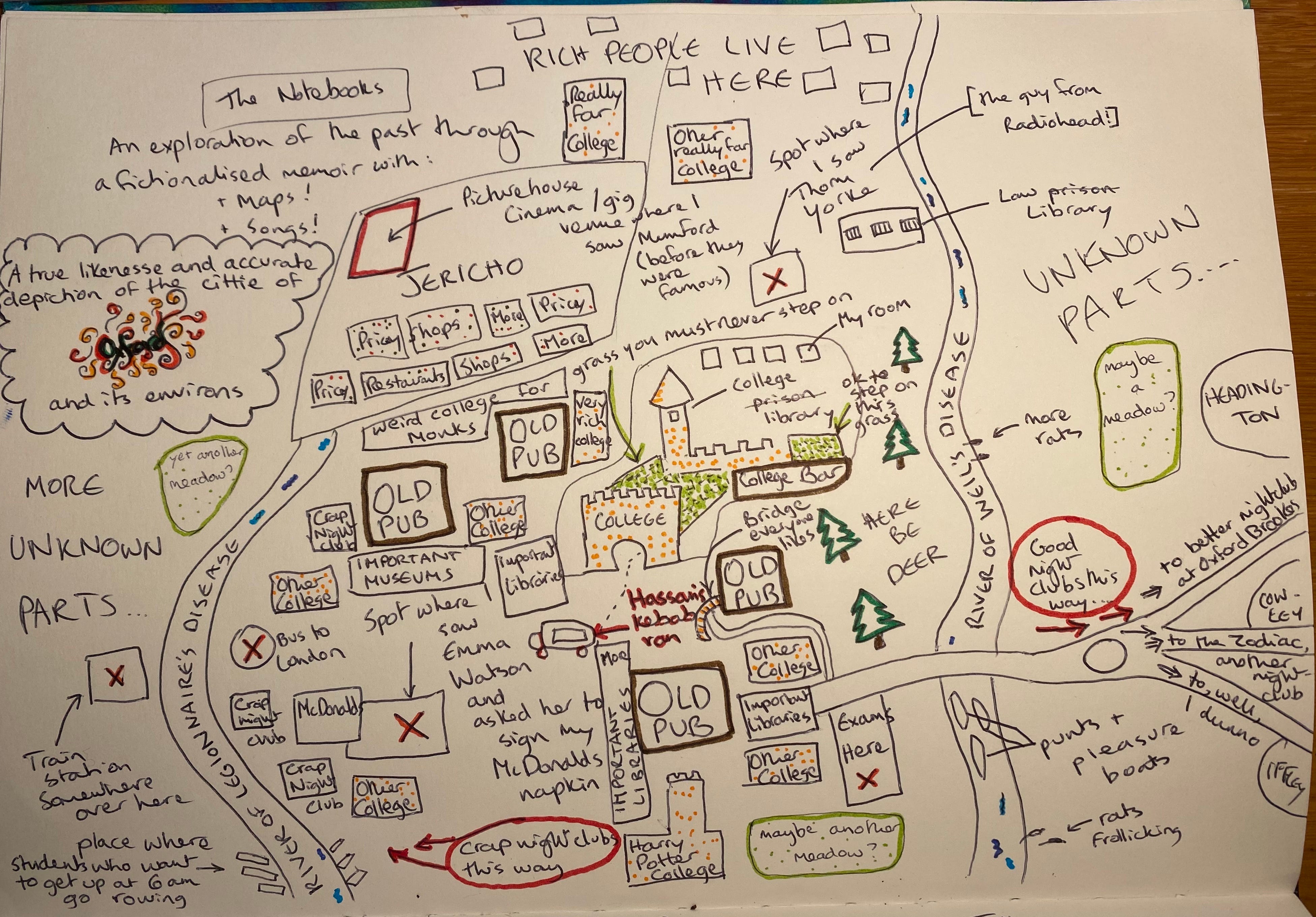
Now, this Oxford has a few (many) gaps. Where’s the covered market? Where’s the High Street? Where are the famous colleges (Magdalen, Balliol)? Where is the pub in which Tolkien dreamed up his maps of Middle Earth or where Clinton didn’t inhale?
Who cares.
This map shows where a hungry student could get a square meal for a fiver (Hassan’s). It indicates clearly that the good nightclubs (the Zodiac and the Pleasuredome at Brookes) were out Cowley way and the shit nightclubs (aptly named Filth and the one above the Sainsbury’s in the old shopping centre) were out Botley way. It includes the prison library. It even shows where a dorky Harry Potter fan asked a 14 year old Emma Watson for her autograph on a McDonalds napkin one wintry night.
Maps are a representation of the world that, by definition, omits things. They don’t show everything; they can’t show everything. A map that showed everything would be as big as the world it mapped and would overlay it perfectly.
Keep reading with a 7-day free trial
Subscribe to Life Litter to keep reading this post and get 7 days of free access to the full post archives.